
 How it’s New York: The show arrives from Sydney Theatre Company to Broadway (or dazzling NYC audiences with its mix of innovative multimedia and old-fashioned storytelling. Oscar Wilde hinself visited NY on a lecture tour in 1882.
How it’s Irish: Oscar Wilde, who wrote the novel of the same name, was Irish.
The skinny, right up front: THE PICTURE OF DORIAN GRAY is a theatrical revelation.
Oscar Wilde is my boo. I have a stuffed Oscar on my desk. I’m convinced my essay about Oscar (his philosophy; he was a serious thinker) got me into college. I wrote one of my doctoral comprehensive essays on the Irishness of Shaw and Wilde, and quoted them both with ease from memory. I took my notes for Succession’s Sarah Snook’s one-woman performance (though one woman multipled by many, see below) on a pad bought at London’s National Theatre, with a picture of Oscar and Bosie on the front.
So I’m actually not the ideal viewer for any adaptation of Oscar Wilde, because I know it so, so well.
Yet I loved this! It was true to Oscar’s intentions while also being theatrically thrilling.
At its heart, THE PICTURE OF DORIAN GRAY is a moral fable (Oscar liked to say that a work could not be moral or immoral, but he was fronting). Sin does not pay. As he’s being painted, he hears Basil’s friend Lord Henry Wotton speak about the fleeting nature of youth and beauty.
Dorian wishes passionately that he could stay the same and the picture age instead.
And so the devil’s bargan begins.
When young Dorian commits a sin, it’s his picture in the attic that shows the wear and tear. He stays looking young and innocent.
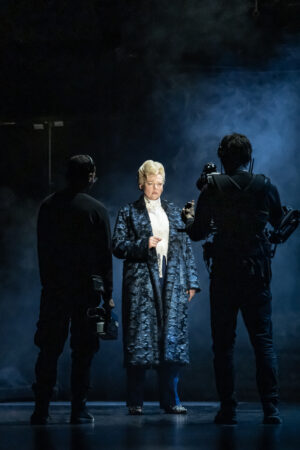
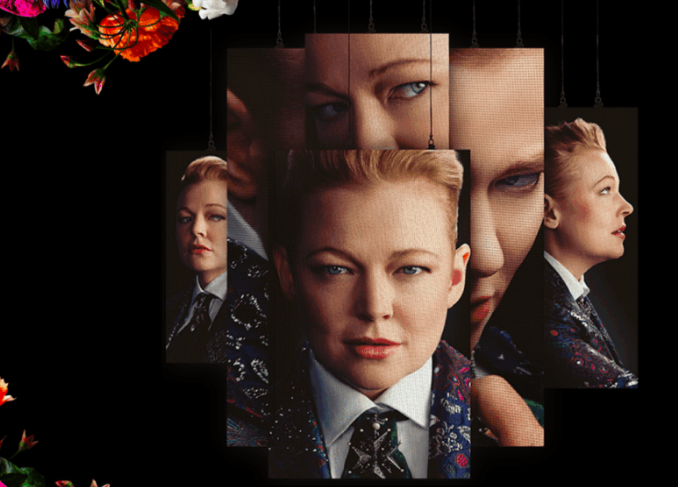
One-person shows can be tedious, but early on, as Snook plays the role of the absolutely naive young Dorian, being painted by Basil Hallward, and a little tempted by Basil’s louche friend Lord Henry Wotton, she seamlessly goes from role to role.
The play would have been watchable if that were its main thrust.
However it is not.
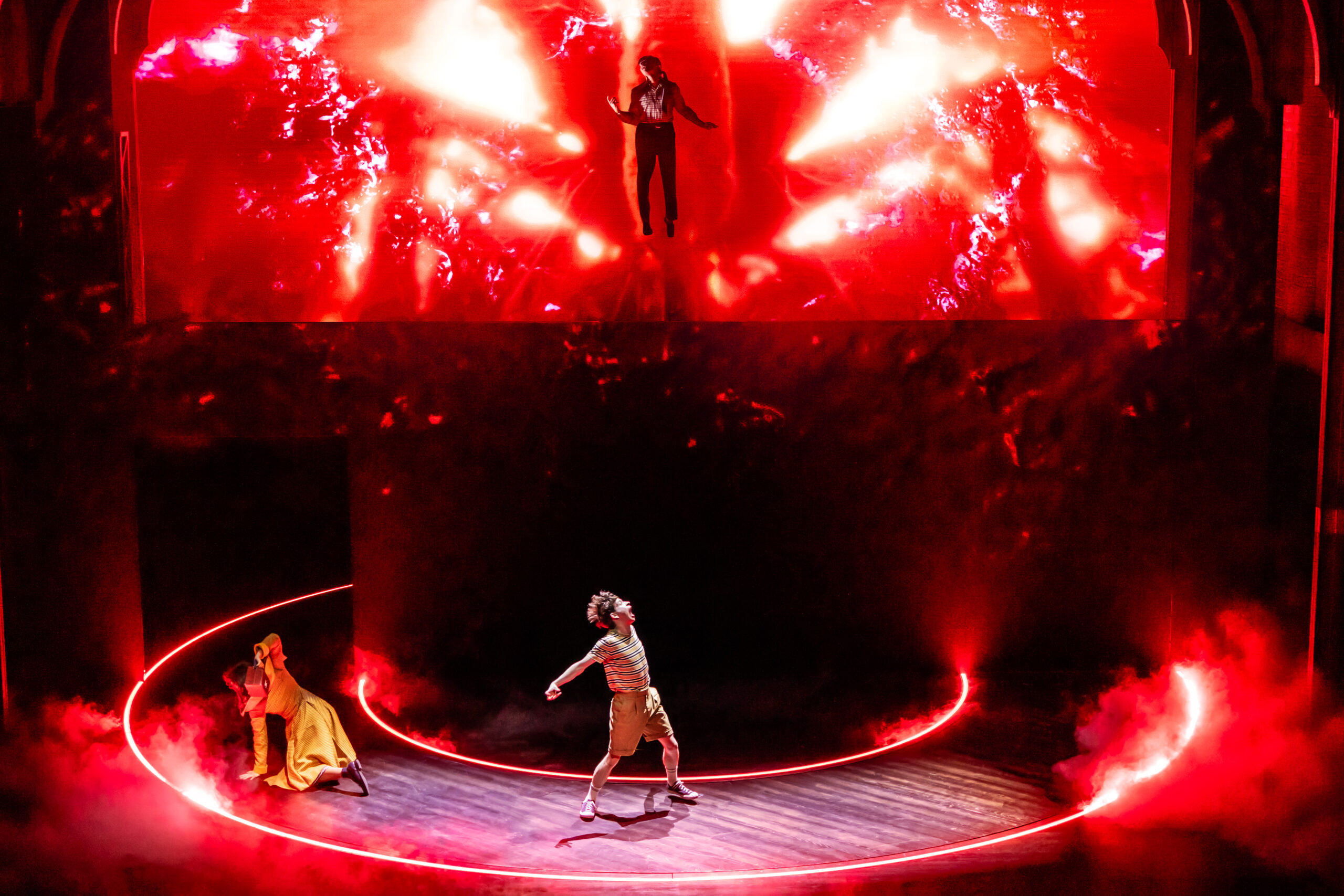
The adaptation, written and directed by Kip Williams brilliantly uses video and lights and sound (video design by David Bergman, lighting design by Nick Schlieper, composer and sound design by Clemence Williams) to fill out the stage. Sometimes it’s in the surface of a stramge, suggestive costume of flowers (scenic and costume design by Marg Horwell), other times we watch as Snook interacts live with recorded versions of herself as other characters. She also does the narration and at times the “her” onstage is visibly frustrated with the voiceover “her.”
At one point there’s an entire dinner party.
It’s endlessly inventive but best of all, it’s always in the service of the story itself.
Young Dorian actually bats his eyelashes, he’s so jejeune.
Dorian’s first tragic misstep is when he rejects the young actress Sibyl Vane– once she loves him she becomes a bad actress, and a sin against art is, to young Dorian, unforgivable. AFter Dorian rejects her, he has a bad night: but it’s too late.
This will come back to bite him later as Sibyl’s brother finds him in an opium den (taken straight out of a 19th century Penny Dreadful; Oscar had clearly never seen one).
Before long Dorian leaps from sin to sin and pleasure to pleasure. Some of this has not aged well: it’s quite the leap from someone being obsessed with gemstones or perfume to someone who is utterly devoid of morality (it would not have been to Victorians, for whom such material obsessions were very sus). And when we’re told that some young men leave the room when he enters, the clear implication is seduction and homosexuality, which, in 1890 when the book came out in serial installments, was still considered as bad a crime as murder. (It was published as a novel in 1891.)

But to its credit the show does not update these things. We watch dismayed as even Lord Henry is startled by Dorian’s despair, refusing to believe the worst of him (but we know it’s true).
The precision of the video interactions is remarkable and effective (though one chase scene goes on a little long). Credit for the precision must be given to dramaturg and creative associate Eryn Jean Norvill too for this.
Despite or even because of the moral downfall and sociopathy we see unfolding in front of us, one pities Dorian. He’s not happy. Every pleasure grows stale. He’s lonely and isolated.
He has forfeited his soul, he doesn’t even know how: and without it, he cannot feel a thing.
Fortunately, you will. THE PICTURE OF DORIAN GRAY is a devilish delight.